
Customer Service Hotline: 0408 763 663
You may have heard people talking about shares in one company and then another group of people talking about stocks in that company and wondered what the difference is. In reality the terms "stocks" and "shares" mean the same thing, the two terms are interchangable however the prevalent term in Australia has traditionally been "shares" whilst in the U.S. they are predominately called "stocks".
Options including "calls" or "puts", can be both bought and sold. Exchange Traded Options gives you the right to buy or sell a particular share at an agreed price (the exercise price) on or before a specific date (the expiry date). When you exercise the option, you take up your right to buy or sell the share.
A call option gives the buyer the right but, not the obligation, to purchase shares (from the seller) at an agreed price within an agreed period sometime in the future, often 1 or 2 months.
A put option gives the buyer the right, but not the obligation to sell shares (to the option seller) at an agreed price within an agreed period sometime in the future.
Good question. There is risk with covered calls which is probably best defined by discussing the likely outcomes of covered call trading.
If the shares offered in the call go up, you will probably be exercised. You will receive the strike price for your shares plus keep the premium. You will miss the opportunity to capitalise on the share gain. Remember you may also pay brokerage.
Some people consider writing (selling) covered calls less risky than just buy and hold stock strategy. Writing options has outperformed just owning shares alone.
There is a bunch of free information online. Start with the ASX web site. It has heaps of free information and training spaces. Also Comsec has a lot of great information. Call me, Tony, on 040863663
The following is an example from memory. Prices may not be exact.
During the GFC BHP prices dropped from about $35 on 1 Aug 2008 to about $24 on 1 Oct 2008. Those people who bought at $35 around Aug 2008 and sold a $35 option earning say 3% found at the end of the option contract period the share price was about $27. They let the option expire. They still owned the shares in BHP @$35. They keep the Premium (3% of the share price x number of shares held) and will also receive share dividends, say 5%, while they own the BHP stock.
In the above example there are a couple of choices:
Then Write another option ATM, about $25, for Oct/Nov 2008; earn income of 3%. Return now 17%. Outcome: Option got exercised as share price closed at the end of the contract period at about $26. Action: Buy the stock back at $26 meaning you now own the BHP shares at @36. BHP shares had recovered to about $37 by 1 Dec 2009, bit over a year since the GFC date, in this example from 1 Aug 2008. Overall 17% to 19.5% on investment in 15 months if picked up an interim dividend before selling the shares.
One of the key things I look for when buying the underlying shares is Bluechip stock… “They are the biggest companies by market capitalisation on the stock market”... so I will be happy to hold the stock for some time if needed. Over the last 15 years I have had to hold some stocks for longer than a year but on only a few occasions. During this period, I had sold an option(s), earned the Premium income and collected the share dividends throughout.
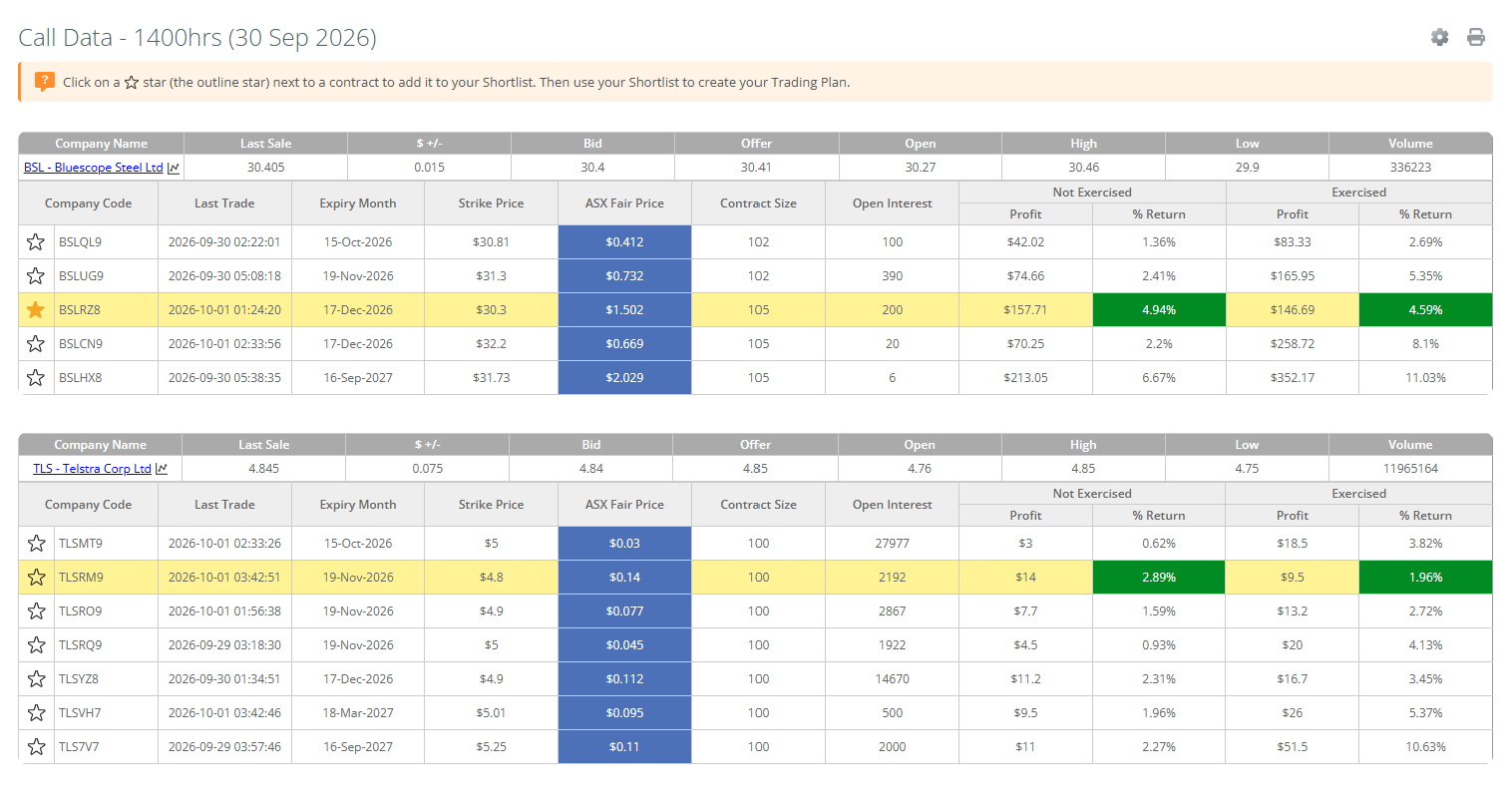
Click to see live BHP, BSL & TLS sample smart report showing Not-Exercised and Exercise Returns. All Companies available in Members Area.

Tony Osborn - Team of One
MyCC is provided as a service to its members. Small, niche, exclusive and operated since 2006.
© My Covered Calls Pty Ltd. All rights reserved. ACN: 125 141 344